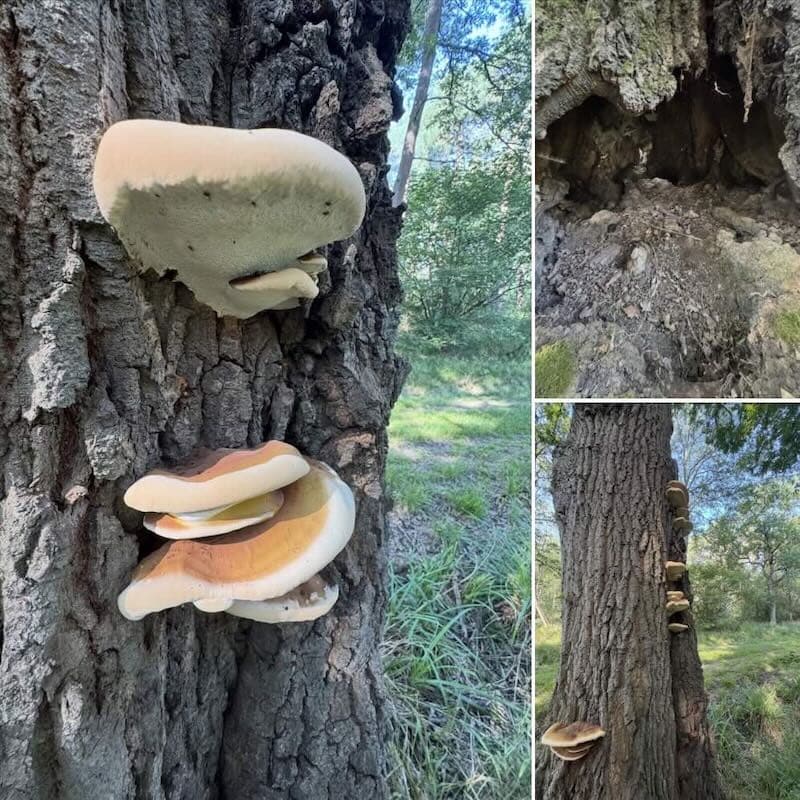
One of our recent tree surveys highlighted exactly why regular inspections are so important — and why they should never be treated as a tick-box exercise.
During a routine assessment, our arboricultural team identified a mature Turkey Oak (Quercus cerris) with Ganoderma resinaceum fruiting bodies present on the main stem, together with a large basal cavity. The tree is positioned adjacent to a well-used bridleway and public footpath, making the finding particularly significant from a safety perspective.
What Is Ganoderma Resinaceum?
Ganoderma resinaceum is a bracket fungus that causes a selective white rot of the stem base, buttress roots and lower stem. While it can be found on several broadleaved species, it is widely recognised as being particularly aggressive on Turkey Oak and Red Oak, where it can lead to significant structural decay and an increased risk of stem failure or uprooting.
What makes Ganoderma resinaceum especially concerning is what you can’t see. The fruiting bodies visible on the outside of the trunk are often just the tip of the iceberg — the outward sign of a much larger amount of internal decay that has been developing over months or even years. By the time brackets appear, the fungus is well established within the heartwood, and the structural integrity of the tree may already be seriously compromised.
Why Regular Tree Inspections Are Essential
This is precisely why visual inspections, combined with further investigation where appropriate, are so important. A trained arborist knows what to look for — not just the obvious signs like fruiting bodies and cavities, but the subtler indicators such as crown dieback, bark anomalies, soil heave around the root plate, and changes in the tree’s overall form that can suggest something is wrong beneath the surface.
Without regular inspections, issues like this go undetected until the tree fails. On a quiet woodland boundary that might mean nothing more than a fallen trunk. Adjacent to a public footpath or bridleway, the consequences could be far more serious.
Retention, Not Removal
It’s worth saying that identifying a problem like Ganoderma resinaceum doesn’t automatically mean the tree needs to come down. Trees provide enormous environmental, ecological and aesthetic benefits, and in many cases they can be retained safely for many years with appropriate monitoring and management. The key is early identification. Spotting potential structural issues before they become critical allows proportionate, informed decisions to be made — whether that’s increased monitoring, targeted pruning to reduce loading on compromised sections, or in more advanced cases, planned removal on the landowner’s terms rather than as an emergency response.
Protecting People and Your Tree Stock
If you manage land with mature trees, particularly in areas used by the public, routine tree inspections are one of the best investments you can make. They protect people, they protect you from liability, and they protect the long-term future of your tree stock by catching problems early enough to act on them sensibly.
Under the Occupiers’ Liability Acts, landowners and land managers have a duty of care to ensure that trees on their property do not pose an unreasonable risk to visitors and users. Regular, documented inspections carried out by a qualified arborist are the most effective way to demonstrate that duty is being met.
Book a Tree Survey
Eden Tree Specialists provides professional tree surveys and arboricultural consultancy across Bedfordshire, Hertfordshire, Cambridgeshire and the surrounding counties. Whether you’re a private landowner, estate manager, local authority or housing association, we can carry out individual tree assessments, zoned tree surveys, and full tree management plans tailored to your site. We offer free, no-obligation initial site visits. Call us on 01234 960796 or email [email protected].